Friday, April 30, 2010

Khanom Chan: Nine-Layer Coconut Tapioca Cake


When I looked at the list of this month's recipes, having finally gotten my head on straight after two weekends of travel, I did not think I could finish them all before May.  I think this month had a disproportionately high number of labor-intensive dough-rolling recipes, too.  Indeed our kitchen has seen a flurry of mad dumpling-making activities over the past week or so.

So I saved this simple recipe for last, knowing I could knock it out on some weekday before work.

This steamed cake is unlike anything I've made before.  I set a cake pan in the steamer and poured in a thin layer of batter, made of tapioca starch and sweetened coconut milk, every three minutes.  The cake ends up with a lot of distinct rubbery layers.  Traditionally the layers are made in different colors, so I made mine various shades of pink and green.  Aesthetics aside, the taste is reminiscent of Play-Doh and the consistency is sort of like extra-viscous Jell-O.  There may be some trick to making this of which I am not yet aware.  Until then - adios, April!

Thursday, April 29, 2010

Pork and Cabbage Dumplings (Mandu)


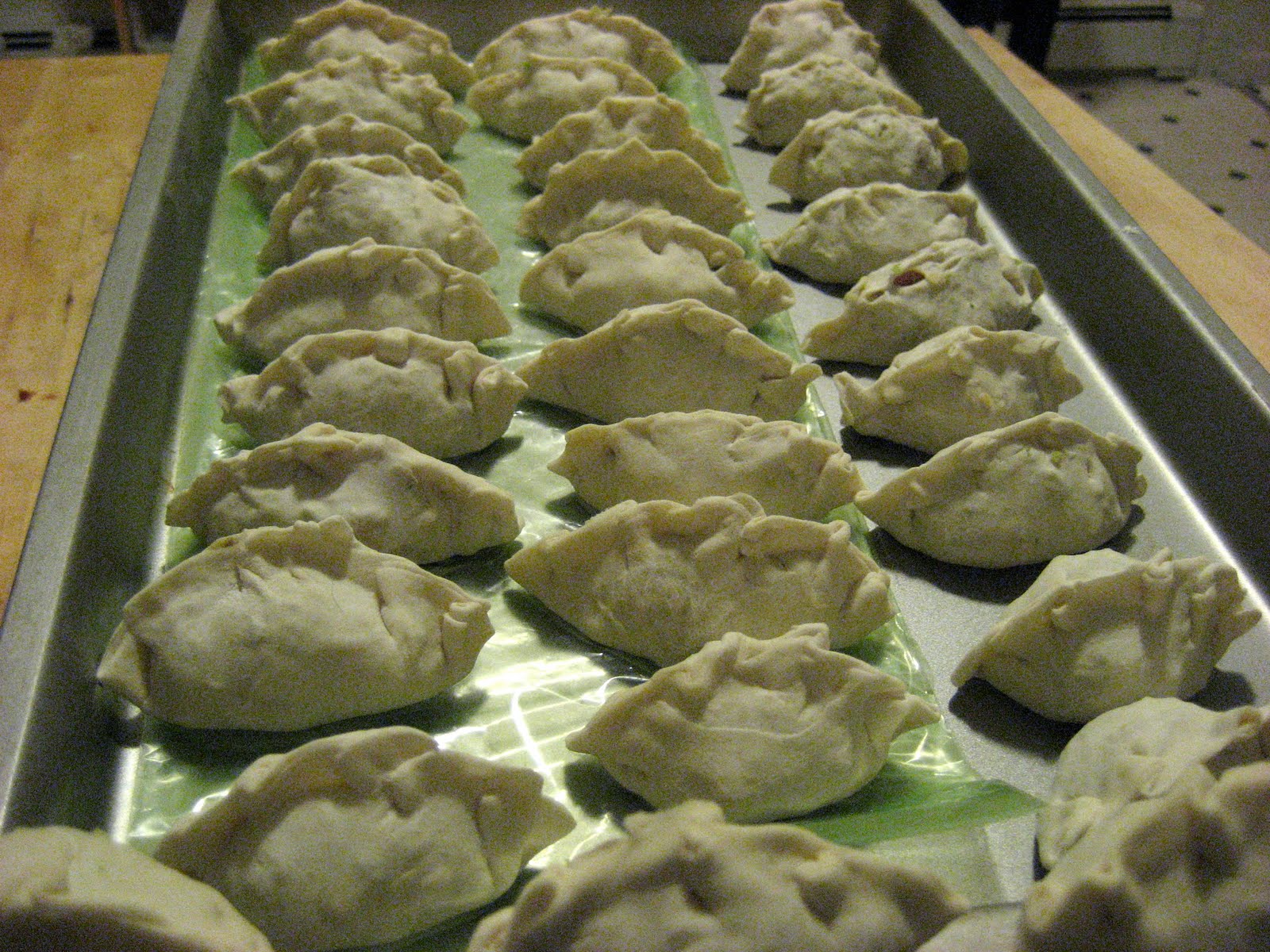
I have to say there's something meditative about making dumplings.  Rolling and cutting dough until you think of nothing else, filling and sealing and shaping just so.  It is sculpture for food.


So I spent yesterday afternoon from roughly five to seven rolling and cutting and filling 49 pork dumplings.  I had spent the morning chopping and mincing cabbage and bean sprouts and scallions and pork until I thought my fingers would fall off.  But at the end of the day, my fingers did not fall off, and I had 30 dumplings in the freezer.

These are time-consuming but awesome.  The filling is bright and fresh with lots of veggies and a kick of ginger and sesame oil.

Wednesday, April 28, 2010

Salty-Sweet Coconut Puddings (Khanom Thuay)


So these are cute.  This was my first try at a traditional salty-sweet Thai street snack.  Both layers are made of some combination of coconut milk, rice flour and sugar.  The bottom layer has more starch and sugar and less coconut cream, while the top layer is mostly coconut cream with a bit of sugar and salt.  Both layers are pretty runny when poured into the cups in the steamer.

The bottom layer sits in the steamer for ten minutes and the top layer for fifteen.  When they're done, the bottom layer is quite gummy and the topping is still a bit runny, but it sets as it cools.

Besides the fact that I can't get them out of these cups without destroying them, these are SO easy to eat.  They're just so small and slightly sweet and gooey and creamy and, well, you can't get them out of the cups without destroying them...

Masa Ball Soup: Supposedly the Easiest Recipe of April


Just looking at this recipe, I knew it didn't belong on the first page of April.  The recipes are supposed to be listed easiest to hardest each month, and, well...

The dough was easy enough to put together - just masa harina, baking powder, salt, shortening, broth, cheese, cilantro and chiles all mixed together.  The problem is, since they're to be floated in soup later, the dumplings need to be fried to seal out the water or else they will disintegrate into the soup.  This wouldn't be a problem except that simply heating oil on my stove sets off the Most Agonizing Fire Alarm on Earth.

So I had to barely fry these at a wimpy low temperature and, bottom line, they didn't quite fry enough.  No matter.  At least I didn't set off the alarm.  They lasted long enough for a photo and lunch, but when I reheated this for dinner the dumplings were nowhere to be found but the soup was pleasantly thick and cheesy.

Tuesday, April 27, 2010

Ashak: Scallion-Parsley Dumplings

I only got one picture of these before my camera battery ran out.  The dumplings are pictured here on a bed of minted yogurt, but without the beefy tomato sauce on top.

I wasn't able to get the garlic chives for the filling, so I substituted equal parts scallions and parsley plus a bit of garlic.  The wrappers are shu mai dough, made of flour, water, an egg, and salt.  They are folded over the filling in the standard half-moon pattern, like pierogies, and boiled in salted water.

Combined with the smooth, minty yogurt and chunky tomato sauce, these herbaceous dumplings are a burst of contrasting flavors and textures.

Monday, April 26, 2010

Spicy Beef Dumplings in Yogurt Soup

I didn't get a chance to plate these before my camera battery ran out, and then we ate them all.  These dumplings are made with a highly seasoned filling of beef, toasted walnuts (recipe called for pine nuts), onion, garlic, allspice, cinnamon, paprika, salt and pepper.  The dough is just flour, oil and water, rolled paper-thin and cut into 2 1/2" circles.

To assemble the dumplings I put about a teaspoon of filling onto a circle of dough, folded the dough into a half-moon shape, and then pinched the two corners together to get a tortellini shape.

I did this about sixty times.

Then I whisked together some yogurt, water, garlic, egg white and dried mint in a pot and brought it to a boil.  The recipe called for strained yogurt but I used regular, so of course it curdled.  I simmered the dumplings for about eight minutes and served them with the yogurt soup.  They were delicious, and so different from anything I'd ever made before.  I did put most of these in the freezer and can't wait to have them again.

Matzo Balls in Beef Stew (Fleischsuppe mit Matzoknepfle)


Of course - no Year of the Dumpling could be complete without matzo balls.  I normally associate matzo balls with chicken soup, but this Alsatian recipe calls for a hearty beef stew.

Although I had used up the last of my Stonyledge Farm stew beef months ago, I had two packets from my last visit to Predel Ranch in upstate New York.  I cobbled together an awesome broth from short ribs, marrow bones, stew beef, thyme, bay leaves, cloves, salt and pepper, an onion and a carrot.  The broth recipe called for other vegetables but I dropped off after the carrot.  After the beef was tender, I separated it from the broth and shredded it for later.

The recipe called for both matzo crackers and matzo meal, but I didn't want to buy a whole package of crackers and use just two, so I used all matzo meal.  I soaked half a cup of the meal (as a substitute for the two crackers) to make a grainy mush, which I then stirred into a pan of sizzling onions, ginger and nutmeg.  After adjusting the water ratio to get a workable dough, I let the mixture cool and added two eggs, some more matzo meal, and fresh parsley.  Then I left it in the fridge overnight.

Once the stew and the dough were made, dinner was a snap.  I brought the broth to a boil and dropped in walnut-sized lumps of dough, covered the pot and let the dumplings simmer for ten minutes on one side, five on the other.  In the last couple of minutes I added the beef and carrots.  The matzo balls were very flavorful and dense, standing up well to the hearty beef stew.

Thursday, April 22, 2010

Manti: Turkish Oven-Simmered Beef Dumplings


For my first attempt at making paper-thin shao mai-type dough, these didn't turn out too badly.  The dough, made from flour, water, egg yolk, olive oil and salt, was a little too thick in places, but still delicious and functional.  Not to mention bright yellow.  The filling called for lamb (I substituted beef), onion, oregano, mint, salt and pepper.  I'm not normally a big fan of mint, but in this recipe it was amazing.

After mixing and resting the dough, I rolled it as thinly as possible, and then cut it into roughly 2"x2" squares.  I put a rounded teaspoon of filling on each one and bunched the dough around it, squeezing the top so that it resembled a little drawstring pouch.  The dough was strong and malleable, and even if it did break in places, the filling stayed put.

This recipe is unusual in that the dumplings are first baked in the oven, then simmered in chicken broth while still in the oven.  I served these with a garlicky-minty yogurt sauce, which was a perfect offset to the hot and little-too-salty dumplings.

Friday, April 16, 2010

Shogo Momo and Sha Momo: Tibetan Half-Moon Dumplings

These two recipes go together because they use the same dough for two different fillings.  They look remarkably like gyoza or fen guo but, like ting momo, the dough is a blend of white and whole wheat flour.  The result is a slightly chewier, heartier skin that takes a little more effort to eat.

The dough is two parts whole wheat flour, one part white flour, and one part water, beaten together to form a not-too-sticky dough, and then left to rest for 30 minutes to an hour at room temperature.  Then the dough should be rolled as thinly as possible and cut into rounds with a cookie cutter or, in my case, an empty water chestnut can.

The first filling is vegetarian: turmeric mashed potatoes.  It contains toasted cumin seeds, one mashed russet potato, a scallion, turmeric, salt, pepper, and cilantro. I think my potato was too small because the filling ended up too salty.  It was beautifully yellow though.  Since the filling was so salty, this one didn't need dipping sauce.  Note that the dough has zero salt, so they sort of balance each other.

The second filling was beef (substituted for yak), onion, scallions, garlic, ginger, cilantro, salt and pepper.  This one did benefit from a little dipping sauce (soy sauce, vinegar, sugar and sesame oil).

Thursday, April 15, 2010

Steamed Chickpea Cake (Khaman Dhokla)

Between travel, taxes and full-time work, April has been a crazy month.  Of course, the April chapter of my dumpling cookbook has some of the most intriguing and complicated recipes too.  I decided to start with this one because it didn't seem as complicated.  The recipes from this month might just have to stretch into May, when I'll have more time for cooking adventures.

This yummy chickpea cake (think spicy - not sweet) has the consistency of cornbread with the satisfying heartiness of beans.  The batter is made of soaked & pureed chickpeas, water, yogurt, semolina, dried chiles, ginger, turmeric, salt and a touch of lemon.  It needs to sit at room temperature for 1-2 hours to soften and ferment a little.  Lastly, I added a mix of oil and baking soda just before pouring it into the cake pan to steam.

After steaming for fifteen minutes, the cake is then topped with a spiced oil (mustard seeds and sesame seeds heated in oil until browned), chopped cilantro and flaked coconut.  The finished cake could be a nice anytime snack; we made it dinner.  The outer edges were breadlike but the interior was still undercooked, so I think I'd steam it longer next time.