Monday, May 31, 2010

Strawberry Mochi (Ichigo Daifuku)


Three firsts came together for this recipe: the first local strawberries, my first time making red bean paste (the first time I liked red bean paste for that matter) and my first time making mochi.  Red bean paste is simply boiled adzuki beans, sweetened, and then cooked down to a doughy consistency.  Mochi is made from ground-up cooked short-grain white rice that is pounded into a bouncy goo much like African fufu.
I was supposed to wrap this extremely sticky mochi around a sphere of red bean paste containing one strawberry.  The problem was that said mochi infinitely preferred to stick to my fingers rather than to the red bean paste.  After the first attempt I thought this recipe was an epic fail.  If I hadn't needed a photo for the blog, I would have given up right then.  Eventually I learned to dust my fingers with potato starch at every opportunity and I think the mochi may have dried a bit as I played with it, because the rest of the dumplings came together with relatively little hassle.
Knowing what I did about mochi and red bean paste going into this endeavor, I did not expect to like these, but they are totally delicious.  The strawberry is a juicy burst of freshness complemented by the earthy sweetness of the red bean paste set against the soft, chewy blandness of the mochi.  Contrary to what the authors say about these being good for only five hours, they have kept well in the refrigerator for a couple of days and are just fine eating cold.  Although I was tempted to eat them all within five hours.

Monday, May 24, 2010

Hot Tamales! Pineapple-Pecan and Tomatillo-Chicken


This was (and I feel like I've been saying this a lot lately) unlike anything I've ever made.  The process is pretty involved and kind of bewildering the first time.  I had quite a time finding the corn husks but in the process I found a glorious international food section at Stop-n-Shop, where I seldom go, so I think the search was worth it.

I made the dough from masa harina, but next time I'd like to make real fresh masa from dried corn and slaked lime.  I have wanted to do that for years now.  For the pineapple tamales, the dough included pineapple puree and panela sugar, and for the chicken tamales the dough was made with chicken broth.  I didn't know what to make of the fact that the pineapple dough was much thicker than the chicken dough, and contained twice as much masa for the same number of tamales.  The filling for the pineapple tamales was chopped fresh pineapple, raisins and roasted pecans.  The filling for the chicken one was chopped cooked chicken legs and tomatillo salsa.


To fill the tamales, I put a blob of dough on a corn husk, spread it into roughly a 2 x 4 rectangle, mounded some filling in the middle, folded the corn husk around it and tied it with a cord.  This was pretty messy because I inevitably got some dough on my fingers and it's kind of oily so I had trouble holding the bundle together while tying it up.  All the while the dough is trying to slip out of every available opening in the corn husk.  It took about forty-five minutes to assemble twenty-nine tamales, plus an hour and a half to steam them.

Time investment aside, it is undoubtedly neat to cook and serve a bundle of food in the same organic utensil.  They are also delicious and definitely best served hot.  I have to imagine that tamales, like most labor-intensive dumplings, are best made with many hands.

Sunday, May 23, 2010

Pounded Cassava Dumpling (Fufu)

To continue the theme of island-shaped food, here we have fufu in a spicy peanut-chicken soup.  Like bread or rice, fufu is a staple food of West and Central Africa.  It may be made from cassava, yam, plantain, or a combination of these.  Said starches are typically boiled and then pounded into a squishy paste.

This was the first time I had ever purchased cassava.  I had to look online to see what it looked like.  After checking four different markets I finally found some at the big Whole Foods under another name - yuca.  The recipe called for shredding the peeled cassava, then steaming it for forty-five minutes, and then mashing the daylights out of it with a blunt object.  Something neat happens during the pounding.  The stuff that starts out looking like raw hash browns turns into a stretchy, uniform mass.

Until now I held the modest assumption that vegetables do not contain bones.  This does not apply to cassava.  Once you shred, steam and mash it, you will discover a handful of pin bone-like twigs in the mix.  I pulled most of them but did end up biting down on one or two during dinner.

Until now I also hadn't thought of soup as a finger food.  But with fufu, yes it is.  To eat it, you pinch off a piece of the fufu, shape it into a tiny bowl with your fingers if it's not too sticky, scoop some soup, and eat the whole thing.  This recipe made a lot more soup than fufu, but that won't be a problem; we'll be happy to have the leftovers with rice or noodles.

Friday, May 21, 2010

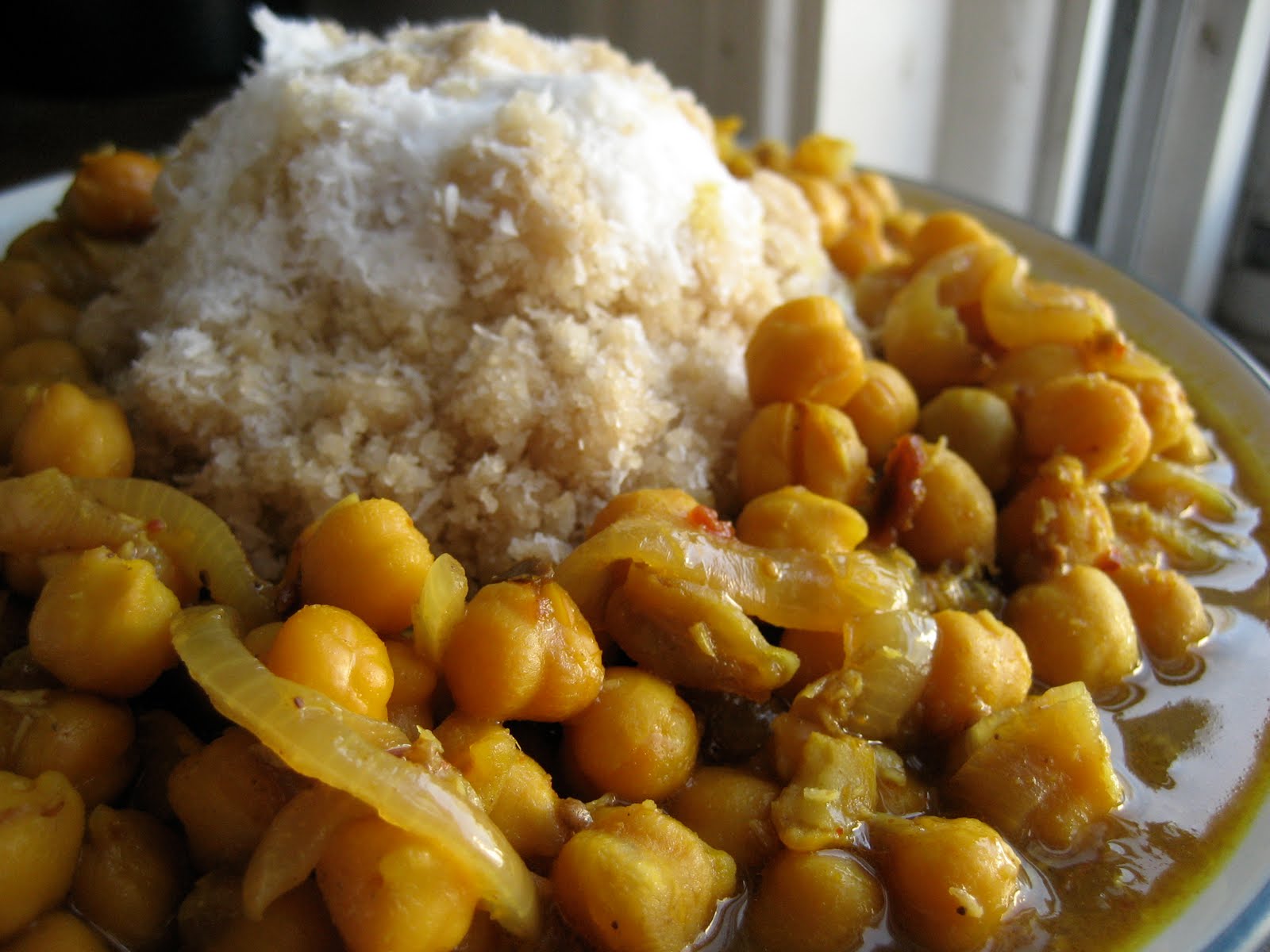
Coconut-Rice Island in Spicy Chickpea Curry: My Take on Puttu Kadala

I am in love with this dish.  I think I felt that way about the last chickpea curry I made too.  Maybe I am in love with chickpea curries.

This recipe starts with simmering chickpeas in a turmeric broth until tender.  Then I made my own masala (spice mix) of coconut, coriander, cumin, fenugreek, chile peppers, cinnamon and cloves.  All my favorites.  After the chickpeas were done I sauteed some mustard seeds, onion, garlic, ginger and more chile peppers together with the masala I just made.  When the onion was cooked I added the chickpeas and enough turmeric broth to cover everything.  Then, for the most important step, I let the stew sit in the refrigerator all day so the flavors could mingle and mellow.

For the dumpling, I ground brown basmati rice in the spice grinder and mixed in salt and coconut milk and let the resulting grainy paste sit in the fridge as well.  This allowed the rice to soften before steaming.  I didn't have the special puttu steamer, and wasn't willing to go and buy one just for this recipe, but I saw on another blog that you can use a sieve instead.  I alternated layers of coconut flakes with the rice-coconut milk mixture in my small metal sieve, set it over a saucepan of boiling water, covered it with foil and let it steam for about 12 minutes.  I was skeptical about the result.  But I gave it a taste and was wowed by the flavor and texture.  It had a fluffy consistency like cous cous and that really satisfying richness that comes from coconut milk and just enough salt to bring out the flavors.

I tried to invert it onto a plate, picked up the pieces and fixed it to look like a dumpling, and poured the reheated chickpea stew around like a moat.  Am I thinking about making this miniature island again for the LOST series finale?  Yes.

Saturday, May 15, 2010

Chewy Rice Balls in Pork-Cabbage Soup (Tang Yuan)

I must have done something wrong here.  I know I took some leeway when I substituted neck bones for the pork butt and simmered everything longer to obtain a gloriously cartilaginous broth.  That move I feel comfortable with.  I did have to keep adding water because the amount the recipe called for wasn't enough to submerge all of the other ingredients at any time.

What confounded me was the dumpling part.  I made the dough as directed: white rice flour plus warm water, mixed and rolled into balls just like the other rice-flour dumplings I've made from this book (onde onde, kube mutli).  The recipe said to drop them into boiling water, boil until they're all floating (about two minutes) and then cook another two minutes.

Well.

After not two minutes, but about an hour of energetic boiling, these leaden dumplings still sat obstinately on the bottom of the pot.  Not stuck - just sitting there.  They had long since turned the cooking-water into a pale starchy soup but refused to float.  I tested them every twenty minutes or so and observed the uncooked center spheres becoming smaller and smaller, but they never decided to cook all the way through.  

End result?  The soup was a little too salty but otherwise delicious, and the dumplings were very, very chewy.  Given the opportunity to use pork neck bones again, I think I'd just stick to plain rice.

Friday, May 14, 2010

Sticky Rice and Chicken Bundles (Nuo Mi Ji)


Ok- I didn't use the lotus leaves.  But I have to say that this recipe is so awesome that I will be making it again and probably next time I'll use the lotus leaves.

A couple of notes: I would use a rice cooker next time to prepare the rice.  I tried it their way - steaming it in a cloth-lined steamer basket, pouring water over and stirring every so often - but when time was up there were still rock hard rice kernels in there.  I cooked it a second time and it was still undercooked at the end.  They said the rice was supposed to be a little undercooked, so I thought that was okay, but in the final dish the rice was still a little hard.  And I have had something like this at dim sum and the rice was incredibly gooey and sticky, not hard at all.

I also omitted the hard-boiled egg and sausage.  In the end the filling was made of marinated chicken, dried shrimp, shiitakes, chopped bamboo shoots and scallions.  Dried shrimp smells horribly fishy by itself, and I was worried that the whole thing was going to taste horribly fishy, but it turns out that dried shrimp is one of those amazing condiments like anchovies and fish sauce that are disgusting on their own but make other things taste good.  I had read about dried shrimp's ability to impart the sought-after umami flavor and until now I wasn't quite sure it was true, but now I know.

Monday, May 10, 2010

Baozi Two Ways: Mushroom and Pork

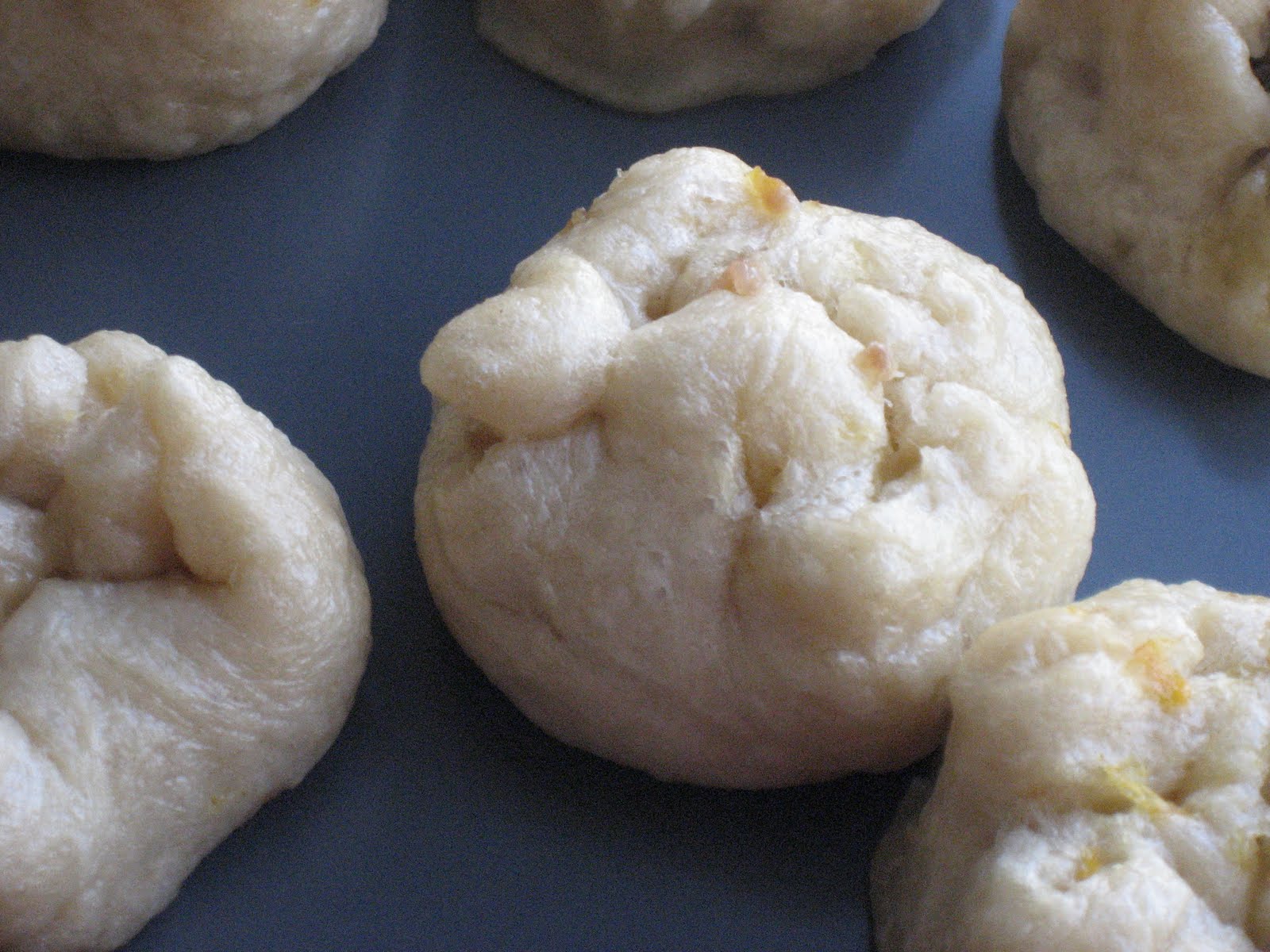
I think these are my favorite style of dumplings.  I typically think of char siu bao when I think of baozi - soft, steamed bread with a red roast pork filling.  The dough develops a shiny skin during the steaming process that makes it taste a little sweeter.

These were made with the same dough as baozi, that is mantou, which is pretty sweet (1 tablespoon sugar per cup of flour) so it rises really fast.  I turn my back on the dough for a minute and it's about to crawl out of the bowl like some sci-fi monster.  Ten minutes and it'd be pushing out the windows of the apartment.  Okay, I'm exaggerating, but to someone who's used to whole wheat dough - which you can let rise forever and ever and it would just sit there heavily, impassively, daring you to turn it into a sandwich loaf - this white-flour dough puffs like a burgeoning marshmallow.

The fillings were similar in flavor and preparation.  I made half of the dumplings with crimini mushrooms (the recipe called for shiitakes but they were more than twice as expensive) and the other half with ground pork.  They were seasoned with soy sauce, ginger and scallions.

Since I was making two different dumpling fillings, I doubled the dough recipe.  After mixing the flour, water, scalded milk, sugar and yeast, letting the dough rise for an hour and a half (apartment remained intact), I kneaded in some palm oil, salt and baking powder, gave  it another fifteen-minute rest, and then chopped it into four parts.  The recipe said to roll out each part and use a cookie cutter (a.k.a. drinking glass) to shape the dumplings, but that doesn't work out so well for me.  Instead I just chopped each quadrant into twelve marshmallow-sized lumps and rolled them out individually.

Each shell got a scoop of filling, edges pinched together on top, and a 30-minute rest.  After that they steamed for fifteen minutes.  These are meant to be frozen after cooking, so I'll cook the rest of these and put some in the freezer because I have a feeling that the two of us can't finish 48 dumplings in three days, delicious as they are.

Saturday, May 8, 2010

Mushroom Bread Dumpling with Asparagus (Schwammerl Knodel mit Spargel)


This was my first jelly-roll-style dumpling.  I baked a loaf of bread, chopped it into bits, mashed it up with milk and egg, flour, sauteed onions and mushrooms, and then rolled it all up into a spiral with blanched asparagus in the middle.  Then I tied it all into a lovely bundle and steamed it for a whopping hour.

Cruelty to asparagus, anyone?

The outside was dense and rubbery and the poor asparagus had seen better days.  But the mushrooms were so yummy and the whole thing tasted like Thanksgiving stuffing.  Overall not my favorite style of dumpling but a new experience nonetheless.

Tuesday, May 4, 2010

Steamed Sesame Seed Cakes (muki goma mushipan)

Mushipan means 'steamed bread' in Japanese.  This version is made like a sponge cake and steamed in little cupcake cups.  I started with triple-sifted cake flour, powdered sugar and baking powder in one bowl.  In another bowl I mixed together three egg yolks, some palm oil and some toasted, ground sesame seeds.  In a third bowl I whipped four egg whites to soft peaks.

I folded the three parts together, a little at a time.  The resulting batter was bright yellow and very fluffy.

The recipe did call for black sesame seeds (kuro goma) but I didn't have any, so I hoped it wouldn't be a disaster if I substituted white.  Next time I might make both white and black versions and construct a little cake chessboard.

These tasted very eggy, a little savory, and barely sweet.  They were of particular interest to our cat.

Monday, May 3, 2010

Caribbean Fish Stew with Dumplings


I'm not sure what these should be called, but the dumplings in this recipe are unlike any I've encountered before.  These were made of typical dumpling materials (flour, water, salt) and cooked in a typical dumpling fashion (boiled until bobbing and then some) but an unusual shape.  Dumplings are usually some neat circle-based form like spheres or half-moons, but these looked more like giant slugs.

Specifically I think this is what Hagrid's flobberworms would look like.  The dumplings ended up rather long - at least five inches long and a quarter-inch thick - in varying widths.  During cooking they kind of twisted into different contortions and ended up looking like meaty fish fillets.  I wondered if this recipe started out as one of those "Ritz apple pie" fake-out dishes that makes a cheaper ingredient simulate an expensive one - in this case flour for fish.

The recipe did call for real fish and I used a pound of sole.  The fillets were very thin and sort of disintegrated during the cooking, but were still very tasty in the pepper-okra-tomato sauce.  The sauce should have been a lot more spicy but I used a humble chipotle instead of the exponentially more fearsome scotch bonnet.

Odd thing about this recipe: the ingredient list includes a sliced scallion and a lime but the instructions don't say what to do with them.  I decided to use them as garnishes and I think that worked out all right.

In the future I'd make the sauce spicier and either leave out the dumplings or make them smaller.  At  present they're just a bit unwieldy for stew.  Looked fascinating in the pot though.