Sunday, December 30, 2007

Our Pet that Lives in the Refrigerator

Not that I would recommend keeping most pets in the refrigerator, but this one finds it the best environment to sleep in. When I take it out and feed it, it springs right awake, ready to jump out of its jar and just leaven something.
Our pet is a thriving yeast colony fabled to have once traveled the Oregon Trail. Because yeasts constantly multiply and regenerate, it is possible for the same strain of bacteria to survive hundreds of years - millions of generations - with proper care and feeding. Refrigerating or even dehydrating the starter just puts the little bugs to sleep, ready to spring back to life with the right amount of food and warmth.
It is possible to "catch" a wild starter using plain flour and water, which capture yeasts from the air. I tried that; it really isn't as easy as it sounds. I recommend, for beginners like myself, to start with a successful sourdough starter, whether it be from a friend, a mythical vendor like King Arthur, or a nonprofit operation like Carl Griffith. Carl's friends supply the Oregon Trail starter for the cost of two stamps. It arrives in powdered form, to be reactivated with flour and water, and has superior flavor and rising power than anything I've made myself.
I maintain my starter with 100% freshly ground whole hard white winter wheat at 100% hydration, which means I feed it equal weights flour and water. I store it in a mason jar, as pictured above, with a paper towel over the mouth secured with a rubber band.
A good starter should smell like bread baking. When fed, it should bubble up and double in size over several hours, then shrink again. There are as many different types and techniques of sourdough as there are people on earth. They're like snowflakes - no two loaves are alike. Slight changes in timing, temperatures and ingredients can produce an infinite variety of breads.
Sourdough Home was influential in teaching me the fundamentals of sourdough baking, as was The Fresh Loaf, but as they all say, there is really no substitute for old-fashioned hands-on experience.
My most recent sourdough experiment was with mini pizza rounds, which I prepared as follows:

Day 1:
Remove starter from the refrigerator and feed with one ounce each freshly ground flour and water.

Day 2:
Add twelve ounces each flour and water to a bowl containing four ounces of starter. Mix and allow to rest in a cool place (not the refrigerator) overnight.

Day 3:
Add three ounces freshly ground flour, two teaspoons sea salt, a tablespoon of olive oil, a tablespoon of Muscovado sugar or honey, and half a teaspoon of baking soda to the dough. It should feel the way a marshmallow looks while it toasts over the fire - puffy and soft - smooth, but not sticky. Knead it gently for a few minutes to ensure all of the ingredients are mixed; the dough really doesn't need that much attention. Over-kneading can cause the loaf to turn into a perfectly flat brick in the oven. Clean out the mixing bowl and oil the inside. Gather the dough into a floppy ball and return it to the oiled bowl, smooth side up. Cover and allow the dough to rise about two and a half hours or until doubled in size.
Divide the dough into sixteen equal pieces. Cut four squares of parchment paper the size of your baking stone if you have one. Place the baking stone in the oven and preheat it to 400 F and get an edgeless cookie sheet or pizza peel ready. Meanwhile, stretch and shape the little dough pieces into 4-6 inch rounds or rectangles. Place four on each piece of parchment and let them rise about an hour until slightly puffed. I didn't cover them. Slide the pizza peel (or cookie sheet) under one sheet of parchment and transfer it to the baking stone, and shut the oven for five minutes. Remove the baked rounds from the stone and replace with another batch of dough. Cook each for five minutes.
Now you have 16 pre-baked pizza shells, ready for toppings. After letting mine cool, I put them in a bag in the freezer. We had two of them the other night, topped with a little tomato paste, fresh spinach and mozzarella cheese, baked for 10 minutes at 350. They're perfect for a quick snack or a make-your-own pizza party, such as I used to have with English muffins when I was little.

Thursday, December 27, 2007

A New Tradition: Cioppino!

Last year, my dad and sister made Cioppino the day after Christmas. We did it again this year, and twice in a row makes it a family tradition! With a meal as delightful as Cioppino, one hardly needs a reason to make it. It's very festive with its red base and bright green parsley on top.

Cioppino is said to have originated among Italian fishermen in the San Francisco Bay area, who 'chipped in' their surplus catch to the common pot at the end of the day, which evolved into 'cioppino' as words do. Another story says it is derived from the Ligurian word 'ciuppin,' meaning 'fish stew.'

My sister got the recipe from elise.com, and we made it as follows:

1/2 cup olive oil
2 medium yellow onions, diced
4 diced bell peppers (two green, two red, all organic!)
3 cloves garlic, minced
1 tsp salt
28 oz canned diced tomatoes
1 bottle clam juice
2 cups tomato juice
2 cups red wine
2 bay leaves
1 bunch parsley, minced, reserving 1/2 cup for garnish

3 pounds tilapia, cut into one-inch cubes
1 pound cooked shrimp, peeled
2 pounds littleneck clams, steamed, reserving liquid

In an 8-quart stockpot, saute onions and peppers in olive oil until barely tender. Add garlic and saute a minute longer. Add salt, tomatoes, clam juice, tomato juice, red wine, bay leaves, and parsley, reserving some for garnish. Simmer 20 minutes.
Add the tilapia and simmer until barely cooked (3 minutes), then add pre-cooked shrimp and clams and simmer until heated through. Serve in warmed bowls with crusty sourdough bread, lots of napkins, and empty bowls for the shells. Go back for seconds. Bon Appetito!

Wednesday, December 12, 2007

Our First Christmas Tree

...is already a few sprigs short. Since we're going to be out of town for Christmas and live in a small apartment, we have no need for a full-size tree. To bring in the festive spirit, I found the perfect little tabletop rosemary bush at Whole Foods and decorated it with snowflake-shaped brads! It's adorable, fills the apartment with a warm piney aroma, and will season many meals to come. It has already found its way into a batch of chicken stock and chestnut stuffing. I don't often use rosemary, but now that it's growing in our living room, I can't wait to start playing with it!

Monday, December 10, 2007

Book Review: Real Food

This book is for anyone who has ever raised an eyebrow at the many unpronounceable ingredients gracing today's packaged foods. The bottom line: put the box down! In Real Food, Planck builds a case for returning to the whole, natural foods that nourished humanity for thousands of years.

Planck begins by sharing her personal history with food, from childhood on a Virginia farm to veganism to eating "meatloaf, bacon and eggs with impunity." The rest of the book serves as an extended definition of the title: what is real food?

While mainstream nutrition tends to treat certain foods as homogeneous, i.e. milk is milk, Planck asks: which milk? She asserts that it is not the food itself that is healthy or harmful, but how it is produced. Raw milk from healthy, grass-fed cows is perfectly suited to human nutrition, whereas milk from confined cows fed grain, animal byproducts, hormones and antibiotics is not. Planck goes on to distinguish between "real" and industrial meat, fish, fruit and vegetables, fats, eggs, grains, salt, and chocolate. Even vilified foods like lard, when prepared as they have been for thousands of years, can be part of a healthy diet.

It may be true that anyone interested in reading a book of this genre is already capable of distinguishing between old-fashioned and processed foods. For me, Real Food summarized most of the conclusions I had already made via self-directed research. The value of the book, however, is just that; Planck synthesizes the available research on traditional foods and delivers it with flair. The questioning reader is free to scrutinize her endnotes and test the legitimacy of her citations.

In a field where extremists are not hard to find, this book is a cool-headed treasure. Some nutrition writers will make you afraid to eat anything - Planck, however, rejoices in [unadulterated] food and has the opposite effect. She encourages readers to eat all the natural foods they like and thoroughly enjoy them without counting calories, fat, or carbohydrates. While she is clearly passionate about the subject matter, she doesn't stray into sensationalism or scare tactics, but remains objective in all the right places. She praises locally grown, fresh vegetables supremely, and makes a substantial case for dietary reprobates like liver, butter and eggs.

Planck takes a controversial and compelling position on saturated fat and cholesterol. Not being a Masai tribeswoman myself, I would not attempt a meat-milk-and-blood diet, nor does Planck recommend it, but I am persuaded that our bodies and foods are more complex than the reigning "if-then" science of fat, cholesterol and heart disease. It is true that every body is different; some can thrive on a vegetarian diet, others on steak and eggs. In addition, Planck does not fail to highlight the importance of exercise for health.

I recommend Real Food as an ideal introduction to the traditional foods lifestyle. There are more scientific works on the subject, but Planck's friendly, conversational tone makes real food approachable and attractive. Her personal experiences and practical advice take the "daunt" out of incorporating traditional foods into very modern lifestyles.

Sunday, December 9, 2007

Mole!

The theme for today's lunch was Mexican. The menu featured Mole Poblano with chicken, black beans in chipotle sauce, Spanish roast vegetables with pinto beans, yellow corn, crumbled Colby cheese and sticky brown rice.
Let's begin with the word mole. It may refer to a small burrowing mammal, Avogadro's number, or a traditional Mexican sauce said to have originated in the Convent of Santa Rosa. The original Mole Poblano contained over a hundred ingredients drawn from Spain, Mexico and Asia. The version I made yesterday was much simpler, but still full of surprises and incredible flavor.

Mole Poblano

1/2 - 3/4 cup organic lard (or olive oil)
1 lb tomatoes
1 onion
3 cloves garlic
7 pasilla chiles, seeded and torn into chunks (I found these long, dried chiles at Whole Foods)
2 Tablespoons ancho chile flakes (the recipe called for whole ancho chiles, but I was only able to find the flakes in the spice section - packaged as a pizza seasoning)
1/4 cup raisins
1/4 cup walnuts
1 ripe plantain, peeled and sliced
1/4 cup sesame seeds
1/4 cup green pumpkin seeds
1/2 teaspoon coriander seeds
2 cloves
2-inch cinnamon stick
2 quarts homemade chicken stock
3 ounces dark chocolate (I used Ghirardelli 60%)
Sea salt to taste
Equipment: spice grinder, blender, sieve

What an ingredient list! Many of these are not common to the average American kitchen, but I was able to find them all at Whole Foods. Unfortunately, Whole Foods did not have the whole ancho or mulato chiles called for in the original recipe, so I substituted extra pasillas. All of these are dried chiles; see pictures here. Plantains look like giant bananas. Look for green pumpkin seeds or pepitas among the nuts.
Begin by oven-roasting the tomatoes, onion and garlic. Slice and spread them on a baking sheet, drizzled with olive oil, and bake in a 350 F oven until soft.
In a heavy pot like a cast-iron wok, fry the torn pasillas and ancho flakes over medium heat for about thirty seconds. Remove chiles from the pan, cover with hot water, weigh them down with a plate and let them soak for about 20 minutes.
Meanwhile, fry the raisins, walnuts and plantain slices in the same pan in batches, then set them aside.
In a dry frying pan over medium heat, toast the sesame seeds and pumpkin seeds, shaking the pan constantly until they are fragrant and golden - about two minutes. Set these aside in a separate bowl. Toast the coriander seeds, cloves and cinnamon stick in the same dry pan, shaking constantly until fragrant - less than 30 seconds. Add these to the bowl with the sesame and pumpkin seeds. In batches, grind the seeds and spices to a powder and set aside.
Return to your chiles; puree them in a blender with the soaking water. Heat 6 Tablespoons lard or oil in a heavy pot and push the chile puree through a metal sieve into the pan, scraping with a spoon. A food mill would also work well for this. Discard solids. Fry until the puree is thick enough that you can see the bottom of the pan when you scrape it. Add two cups of chicken stock and keep everything at a simmer.
Puree the roasted tomatoes, onion, garlic, raisins, walnuts and plantain in batches, adding a cup of chicken stock to each batch. Add to the simmering chile mixture together with the ground spices. Lastly, add the chocolate and simmer for an hour.

I refrigerated the mole overnight and baked the chickens on Sunday morning. The chickens, which I purchased at the farmers' market on Saturday, had been sitting in brine in the refrigerator all day. To bake them, I cut them into large pieces, piled them in my 6-quart stockpot, put the lid on and baked them at 300 F for about 4 hours. I removed the meat from the bones and mixed it with boiling mole sauce and some of the roasted onions and peppers and garnished it with crumbled Colby cheese and parsley.

For the rest of the menu, I sliced and roasted eight bell peppers, three pounds of onions, a butternut squash, four green zucchini and a pound of crimini mushrooms. I also cooked a pound each of black and pinto beans, which had been soaking at least eight hours. I mixed the pintos with the roasted vegetables and seasoned them with smoked Spanish paprika. The black beans received a deliciously smoky, garlicky...

Chipotle Sauce

1 lb. roasted tomatoes
2 dried, grated chipotles soaked in a Tablespoon of cider vinegar
4 cloves garlic, smashed
1/2 teaspoon ground cumin
1/2 teaspoon oregano

Puree in a blender.

My purpose with this menu was to expand my perception of Mexican food beyond the usual fajitas, burritos and enchiladas, fantastic as they are. It was a marvelous learning experience that I loved sharing with our guests. The process of preparing food is about so much more than just eating - it's sharing a culture and a tradition. There's a whole world of culinary traditions to explore and I can't wait to try more.

Sourdough Buckwheat Waffles Take II


As promised, we had sourdough buckwheat Belgian waffles again this morning. This time I added a half-teaspoon of vanilla and a teaspoon of a slightly bolder cinnamon - Korintje Cassia. It's worth it to make these just to smell them cooking, let alone eat them. We topped them with fresh apples stewed in a little butter and Ceylon cinnamon, yogurt and local honey.

Saturday, December 8, 2007

Sourdough Buckwheat Waffles


Since I began experimenting with traditional food, these were the best waffles I have ever made. It was originally a Belgian waffle recipe, which called for yeast, that I adapted to use a sourdough starter instead. My starter is made of equal weights flour and water, so I just replaced an ounce each of the flour and liquid called for in the recipe with two ounces of starter.

I started last night by soaking 2 ounces starter with 1 1/2 ounces freshly ground organic buckwheat and 3 ounces fresh milk. In the morning, I mixed in a teaspoon of Muscovado sugar, a Tablespoon (half-ounce) melted butter, an egg, a teaspoon of Ceylon cinnamon, a quarter-teaspoon of salt and a quarter-teaspoon of baking soda.

These puffed up like crazy in the waffle iron, oozed all over the counter, and came out perfectly soft on the inside and crisp on the outside. The cinnamon really made them special. We had them with blackberries (out of season, but on sale), yogurt and local honey. I will definitely make these again. In fact, my batter is already mixed and we're having them tomorrow!

Sunday, December 2, 2007

Feast of Keangs


Today we celebrated the first snowfall of the season with a tropical Thai feast. Since my shrimp adventure, I have learned more about the proper way to prepare homestyle Thai cuisine, even without a mortar and pestle. The flavors themselves, in addition to the ways in which they are layered and contrasted, make Thai food unique.
The menu for today's lunch, from Cracking the Coconut, consisted of cucumber salad, stir-fried pork with shrimp and pineapple, red curry with roasted pork and plantains (Keang Pet), Thai-Indian chicken curry (Keang Kari Gai), and sticky brown rice.
The cucumber salad was crisp and refreshing, made of two cucumbers sliced on the diagonal, two green onions likewise prepared, and a few splashes of dressing made from a half-teaspoon sea salt, a quarter-cup each of fish sauce and Muscovado sugar (not packed), and the juice of five limes.
The stir-fry, besides the obvious ingredients, was distinguished by its seasonings of fish sauce, bird chiles and dry-roasted freshly ground white peppercorns.
My primary occupation on Saturday was the preparation of chile pastes. Chile pastes are the cornerstone of Thai cooking and mixing them is an art passed down through generations. When made from scratch, the depth and complexity of flavors is out of this world. They are time-consuming, but worth every second. Just make big batches and freeze the leftovers!
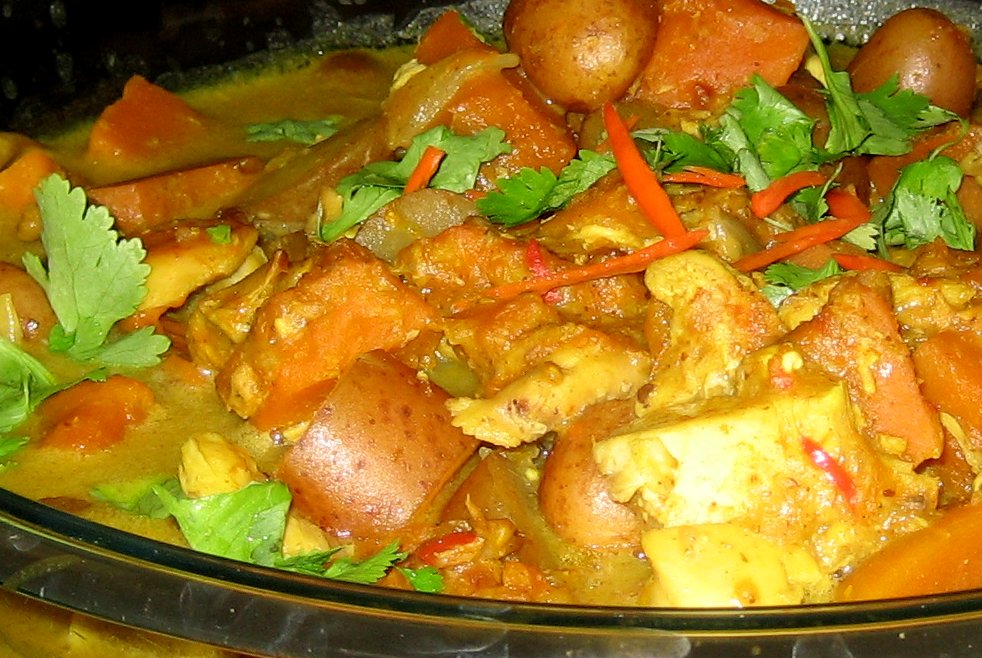
My two curries, Kaeng Kari (pictured above) and Kaeng Pet were seasoned with these homemade chile pastes, cooked in coconut milk with vegetables, and finished with fish sauce, sugar and fresh chiles.

Keang Kari (Thai-Indian Curry)

6 heads garlic
3 shallots
1 inch fresh ginger

Slice tops off garlic and shallots, toss with olive oil and oven-roast at 400 F until soft. Squeeze softened garlic and shallots from their skin into a bowl; mince ginger in as well.

1 Tbs. coriander seeds
1/2 tsp. each cumin and coriander

Dry-roast seeds in a skillet until fragrant and grind in a spice grinder.

1 tsp. sea salt
7 bird chiles
2 Tbs. curry powder
1 stalk lemongrass, hard outer layers removed, minced
1 tsp. turmeric
1 tsp. fermented shrimp paste (find at Asian markets)

Using the end of a French rolling pin or other blunt object, pulverize softened garlic, shallots and ginger together with sea salt. Scrape into food processor and blend. Crush chiles and lemongrass likewise, toss in and blend. Add ground spices, curry and turmeric, blend. Lastly, blend in shrimp paste. The shrimp paste adds a unique flavor and binds the paste together.

1 whole chicken
22 oz. (1 1/2 cans) coconut milk
1 Tbs. Muscovado sugar
2 Tbs. fish sauce
2 yellow onions, diced
1 pound potatoes, diced but not peeled
1 kabocha squash, peeled and diced
5 bird chiles, julienned

Cut chicken as best you can into bite-sized pieces and simmer in a saucepan with coconut milk. I find it easier to separate the meat from the bones after the chicken is cooked. Meanwhile, add 3/4 cup of the curry paste to a skillet with a tablespoon of coconut oil, cream or milk. Add the chicken parts to the curry paste with a little coconut milk and stir to coat, then return everything to the saucepan of simmering coconut milk. Bring it to a boil and add sugar, fish sauce, onions, potatoes, squash and chiles. Simmer until potatoes and squash are tender. Squash cook faster than potatoes! Garnish with julienned red chiles and cilantro leaves. This curry was milder than the Keang Pet and one of the most delicious I've ever made. I think it was the guests' favorite.

Keang Pet followed a similar technique. The curry paste included white peppercorns, lots of chiles, nutmeg, galangal and lime zest, and left out the curry powder and turmeric. The pork was marinated in crushed garlic, ginger, soy sauce and unsweetened mango jam, then roasted and fried with the curry paste and coconut milk as the chicken was in the previous recipe. It simmered together with sliced plantains, an onion, three green peppers, fish sauce, salt, sugar, and lime zest, then received a garnish of julienned green chiles. This one was very strong and spicy. Next time I would use green bananas instead of plantains, which I found too mealy and bland.

So play with your food! Break out the mallet and crush your garlic, ginger and chiles. Dry-roast whole spices and grind them yourself. Build layer upon layer of flavors and bold contrasts: salty, sour, sweet and spicy - and that's just the beginning.